Tuesday, February 4, 2014

Thoughts on Thinking - Part 1


I recently finished the book Thinking edited by John Brockman. The book is a collection of articles by experts on various subjects all loosely related to the human thought process.  As I read the book, I underlined and took notes. This blog posting is a review of my notes and some of my opinions on the articles and topics.
The book has 14 different articles and they are of uneven quality and interest to me. Fortunately none of them are too long - and even the uninteresting ones exposed me to a perspective I would not normally see. Since that is what I was looking for - different perspectives by smart people - I was satisfied with the book and would consider buying more books in the series.
In this posting I will only touch on the first two articles. My reviews are not meant to be objective - and they may not even be accurate portrayals of what the author says. It reflects my thoughts on what I think they said.

Daniel Dennett ( a collection of mini-articles )

Dennett's chapter was the first in the book and was itself a collection of unrelated thought pieces - which I call mini-articles. It felt more like a blog - and each topic was a different blog post.
The Normal Well-Tempered Mind : This was Dennett’s most interesting mini-article. In it he describes the brain/ consciousness as a collection of agents (neurons / specialized areas of the brain etc) that are perpetually in cooperative competition. Each agent is striving to increase its own control and importance and it does so by learning new skills (neuroplasticity), and forming alliances. Consciousness arises out of this blend of competitive/cooperative anarchy/democracy among the many brain agents.  This approach to describing consciousness was similar to one I recently read in Neal Stephenson’s book Anathem. In that book, a theory was presented that portrayed the brain/mind as a collection of specialized agents that struggle to survive in the face of a constant stream of information/threats. Consciousness represents the method of communication that these agents developed to survive. And our sense of self is the embodiment of that collective behavior. Our internal narrative is an aspect of this collective. It forms from fundamentally different areas of the brain struggling to form common ground.  I found Stepehson’s description of consciousness more compelling. Dennett’s model is similar, but different enough (with his focusing on competition a bit more) to be interesting.
There are a Lot of Cultural Fleas.  This article starts with the assumption that language is an inherent human skill. Through language culture is passed from one generation to another and this pattern is one of our greatest evolutionary advantages. It appears that this is all “a given” to Dennett - though I note that a later chapter in the book challenges this thinking about language Dennett’s point to this article is that we normally assume that culture and the evolutionary pattern of thinking is all good - that what survives from generation to generation is the good stuff. But much - if not most of what survives is bad stuff (cultural fleas as in the title to the article).
Naive Science of Free Will.  Dennett’s mini-articles start to deteriorate quickly through the rest of his chapter. They turn into opinionated rants.  The main point of this particular rant was: Scientists talk a lot about free will - they should shut up and listen to philosophers - who have a lot to say on the subject.. Dennett is of course a philosopher. He must have just had a bad day with a scientist.
A combination of arrogance and cravenness / A pernicious sort of lazy relativism  These are actually two mini-articles that make the same point - which is: that religious leaders / pastors stink. They lie and they know they lie all the while pretending they are doing good. People look to them as experts on life and science and they make up stuff and lie. Bad! Bad! Bad!. Really BAD.

My closing remarks on Dennett’s chapter: I was disappointed. I had heard of Dennett and was looking forward to reading some of his work. I came away with the impression that he was a  “professional atheist” and an “expert thinker”. To me, these are not good things.

After I finished the entire book and started to reflect back on the individual chapters, I found several chapters related in some unexpected ways. I mentioned already that Dennett’s “givens” about language were challenged in a later chapter. The next chapter in the book discusses “experts” - which is what I described Dennett as being. The most important relationship with other chapters ties into Dennett’s moral indignation about religion/pastors. A writer in a later chapter describes morality as being that system of thinking which supports your particular world view (or view of reality). My own world view is different enough from Dennett’s that when I read his anti-religion rant - I felt it could be equally applied to him.

How to Win at Forecasting by Philip Tetlock

I will admit I have heard of Tetlock’s work at least twice before - and was already favorably disposed to his topic and conclusions. So this is the third time I have heard of the same research - which adds to its credibility - and it agrees with my world view - which gives me moral certainty. Also, Tetlock makes positive references to Popper, Taleb, Kahneman and  Bayes. and he makes a negative comment about Tom Friedman. He is batting a thousand. So to me this is no longer an interesting piece of unverified research by someone making a career off of this same research. It is now a TRUTH.
What is this TRUTH? It is simply - Experts stink!  They lie and they know they lie all the while pretending they are doing good. They make up stuff and lie. Bad Bad Bad. Really BAD.
Oh wait, I wrote that before - about Dennett’s opinion of religious leaders. And here it is again - but this time more generically applied to all experts.
Ok Tetlock doesn't really say all that. His point is we overrate expert opinion and that in many cases experts do no better than random or naive systems - and in many cases they know they are no better and simply don’t care. Many experts are not held accountable for their predictions of the future. They are paid to make forecasts - not to be right.
Tetlock’s research focused on political experts and their ability to predict the future over a decade or so. He found that they really didn’t do well and that in many (most) cases you are better off with a random or some simplistic decision tool than taking an expert’s advice. One reason you might be better off without the expert is that experts tend to stick with a previous opinion long after the facts change. If you have read Silver’s  The Signal and the Noise, this will all seem familiar.
Tetlock also describes people who are willing to engage in this research. Entrenched experts and companies do not want to hear about or engage in this research - because it challenges them and their expert status. He says a lot more on the need for verification and the need of this research. If you want to donate to his cause - I’m sure there is a way.

All in all, I was happy to read this piece - but it didn’t add anything to what I had read/heard elsewhere. It is interesting how this same research is spreading around  (a “meme”?). I struggle with an article like this because I agree with its fundamental point - which makes me wonder - what am I missing? When you hear something you really want to believe, you are either misunderstanding what was said or you are fooling yourself. So I tell myself - “perhaps”.

Monday, August 22, 2011

Neuroplasticity - Part 1

Neuroplasticity refers to the brain's ability to change itself structurally in response to stimuli. I'm reading about it in the book Train Your Mind, Change Your Brain by Sharon Begley. Its a good book.

I find the book and overall topic particularly interesting because it intersects with a bunch of other things I am interested in - such as memory training, expertise, mindfulness, networks (as in the brain being a network), chess - I could go on and on. I am calling this "Neuroplasticity - Part 1" because I am only about half way through the book. But I wanted to get a couple of my thoughts down while they are still fresh.

First, as I was beginning Train Your Mind, Change Your Brain, I was just finishing the book Moonwalking with Einstein by Foer which covers his experience training for the US Memory Championship, but also touches on  a host of interesting topics - in particular, training the mind or body to become an expert (in anything). I recommend it.  These two books fit together perfectly and together could form the basis of a whole bunch of interesting blogs. What a rich area this is!

Second, Train Your Mind, Change Your Brain fits in with cognitive behavioral therapy, the subject of my last blog.  The first half of  Train Your Mind, Change Your Brain covers primarily early experiments and findings in the subject of neuroplasticity. In general, this area of the book covers the brain's ability to change structure in response to outside/physical stimuli. For example, in blind people the area of the brain typicaly used for optical processing will start responding to other types of stimuli - such as spacial and sound processing. Or stroke victims can retrain other parts of their brain to handle the work previously done by the stroke damaged areas of the brain. Using various scans, scientists can measure the new brain activity and changes in brain size caused this external stimuli.

The second half of the book (which I am starting now) takes up the subject of the brain changing in response to internal stimuli. Much to my surprise, it starts in on cognitive behavioral therapy (see my last blog) and experiments done on patients suffering from OCD (Obsessive Compulsive Disorder). This is a quote from the book on a Dr Schwarz discussing the experiment's findings:
"Therapy had altered the metabolism of the OCD circuit" says Schwartz "This was the first study to show that cognitive-bahavioral therapy has the power to systematically change faulty brain chemistry in a well-defined brain circuit." The ensuing brain changes, he said, "offered strong evidence that willful, mindful effort can alter brain function, and that such self-directed brain changes - neuroplasticity- are a genuine reality."
So the evidence on CBT is not just that it seems to work, but that it can cause measurable and lasting changes to the brain structure. Totally cool!!  As I like to say: be careful with what you think!

P.S. Of course this could also tie into my Michael Lewis blog relative to my comments on the social construction of reality. If our brains physically change in response to stimuli, then the socially constructed belief system within which we all live forms a constant directed stimulus which will  physically affect our brain wiring - perhaps then reinforcing the belief system. This would certainly explain some of the psychological trauma that occurs when a person perceives a falseness in this social reality (what I called the universal story). And of course all this ties into David Hume....

Thursday, August 4, 2011

Cognitive Behavioral Therapy - A Western Guide to Eastern Thought

Back when there was still a Borders bookstore, I would regularly receive emailed coupons for 30% or 40% off a single item. I would then go wander through the store looking for something - anything - I could buy with that coupon. My journey through the stacks would take me first to chess books, then graphic novels, then math and science, sometimes history and in the end - eastern religions. It happens that right next to eastern religions was psychology, and in that section I saw a big yellow book called Cognitive Behavioural Therapy for Dummies [its British so its spelled funny]. I will confess, I'm a sucker for Dummies books on complicated sounding subjects.

Here is the Wikipedia link to Cognitive Behavioral Therapy  (CBT), but I will give you my key takeaways. CBT is a higly successful therapy technique which is based on a person taking an active responsibility for their own mental health. In a sense, a person becomes their own therapist and CBT offers advice and tools to use in this task - so its really a methodology.

CBT is scientific in its approach. It encourages a person to analyze their problems, break them into pieces, theorize how these pieces work together and then test their theory. Analyze, theorize, test, repeat - and document everything. Essentially you use the scientific method on yourself. Its sounds scarey, so maybe the ABC form will illustrate what I mean.


ABC Form

The ABC form is a tool that you can use to analyze a bad situation - lets say you became angry at a coworker and you stormed out of a meeting. Start with C first - it stands for Consequence. The consequence is that you became angry and stormed out of meeting - simple enough. Now go to A - or Activating event. This isn't so easy because you need to strip the activating event of its emotional content - its just an event - nothing more. In this case Susie (your coworker) said: "Bob [you] has not finished his assignment for this week". That is A. B stands for Belief and connects the activating event to the consequence.  Lets say the belief is "Susie was belittling me and thinks I am worthless (maybe I am)". You write all this down on a piece of paper which we will call the ABC form.

The basic idea of ABC is that an activating event occurs, it triggers a belief, which then triggers consequence. The thought model most people use is: "I stormed out of the meeting because Susie was an asshole and made me mad. I'm not responsible, Susie is." With ABC , Susie isn't responsible for your storming out. Susie said something which you then interpreted with a negative belief which you then allowed to trigger your storming out mad. You and your beliefs are in charge of what you do, not Susie. [I note that the A and C don't have to be external events. It could be that the activating event is a random thought that comes to you and the consequence could be a resulting depression.]

Now look at the ABC form with a scientific eye. Did Susie really say what you think she said [Question the A]? Does she really think I am lazy and was she really belittling me? [Test the B: what other evidence do I have for and against] Maybe what she said was true and she was just stating a fact. [was it?] Maybe she was just having a bad day and it came out wrong?  Even if you can't disprove your theory that she was belittling you, maybe you can come up with alternate theories that work just as well. Or maybe you find that it is not Susie who thinks you are lazy, you think you are lazy.

After all of this, even if you decide you were probably right about Susie - you still need to deal with the consequences. You stormed out mad. As Dr. Phil would say, "How did that work out for you?" Did the consequences - your own behavior - help or hurt?

The above discussion of the ABC form illustrates that CBT is 1) self driven and 2) scientific. My last key takeaway from CBT for Dummies is that it that CBT is about being mindful as opposed to judgmental. In the above ABC discussion, Bob might unfortunately come away thinking, "Oh there I go again. I'm such a hothead - an idiot. If I were a good person I wouldn't behave like that." But CBT doesn't mean for you to cast judgements on yourself. Just note things. With the ABC form, you analyzed the situation, created and tested alternate theories and you reflected on whether your beliefs and actions were helpful or unhelpful in your life. Now accept the situation and move on. Just be mindful and going forward note your own actions and belief systems. This will lead you in the right direction.

There is a lot more to CBT for Dummies. A lot of it has to do with methods to document and explore unhelpful beliefs and different approaches for testing and facing them. CBT is all about facing your problems and testing your fears. And its all about documentation - very scientifc. Rate your fear of heights on a 1-100 scale. Now go stand on a ladder and rerate your fear, etc.  The thing I found interesting about this area of the book was that avoidance behaviors due to a fear are almost as bad as the fear itself.

Buddhism and CBT

When I originally picked up the book at Borders, as I said before, I had been looking in the section on eastern religions and I happened to see this book in the next section over - in psychology. When I flipped this book open, my eye fell on the word "mindfulness". I thought, "mindfulness - that sounds Buddhist, did this get put in the wrong section?" As I read the book at home, the thought that this was a Buddhist book never really left me.

Or perhaps its the other way around - Buddhist teaching really belongs in psychology. After all, Buddhism is a cognitive behavioral therapy technique. Its about dealing with suffering through exploring your beliefs and behaviors. In Buddhism, you take responsibility for your own thinking, behavior and path to nirvana. You guide the process.  Buddha's teaching are scientific. He said, "Don't take my word for it- you need to come explore this for yourself and make it your own." Buddhist teachings are non-judgmental. They talk about accepting what is, being mindful of your thoughts and actions and being aware of what is helpful and unhelpful.  And Buddhist teachings talk of being careful of what you believe (attachments), and equally careful of what you avoid.

Obviously there is a lot more to Buddhism, as there is more to CBT.  But the part of Buddhism I am particularly interested in is not its cosmology or any particular doctrine. The aspect of Buddhism I am particularly interested in is that it can be seen as simply an approach to living your life as best you can - day to day, minute to minute. Its about right now, plain and simple. 

CBT is a powerful technique - and its meant to help people with real problems. People with anger, fear, suicidal thoughts, phobias, addictions.... real suffering. These problems have to be dealt with in the here and now - and every day.

 I don't want to end this on a heavy note. I feel strange saying one of the world's great religions is "just" a therapy technique and that a modern day Buddha would have a couch and charge by the hour.  Maybe the difference is that for a Buddhist, this technique is not a technique but a way of life -and that is a serious difference. But I do find the similarities between CBT and Buddhism striking, and I choose to think that the Buddha would be happy with that.

Tuesday, July 19, 2011

Reflections on: The Big Short by Michael Lewis

I had told myself to stop reading financial books - brings back too many bad memories - but I made an exception with this book. Why? Partly from friends' recommendations - but mostly because I respect  Michael Lewis as a writer.

Strangely enough, I don't typically like Lewis' books while I am reading them. I find them hard to get through. The plots (if you can call them plots) are slow and filled with too much minutia to be called a fun read. But, none-the-less,  I find myself compelled to read on and finish the books. And in the end, I'm very happy I did.

In The Big Short, Lewis tells a story, well actually several stories, of individuals who shorted the mortgage market just prior to the market debacle a few years ago. They were betting that the mortgage market would collapse - and it did. He talks about their personalities, the reasons behind their convictions, their difficulties in executing their strategies and a host of almost amusing anecdotes. In the end they were right and their shorts paid off. On this level, I found the book just painful. Perhaps others readers may be amused or alarmed by those stories, but not me. Given my history, it was just painful.

So why am I ultimately glad I read this book? Because this book is not about its plot.  Lewis puts his real story under the surface.

In good poetry or art - images are presented to the reader/viewer. What these images mean depends at least in part on the viewer. The goal of the artist, or in this case the author, is to present images that are rich with content such that when the viewer sees it, meaning emerges. I believe that the defining characteristic of art is that the viewer/reader must interact with it to create meaning. An artist is someone who creates a medium (poetry, painting, books....) that is rich in content that encourages its viewer to create meaning.  Michael Lewis is an artist.

In The Big Short, Lewis' plot and anecdotes are just foils to tell a more gripping story - what I call "The Universal Story".  I can't tell you exactly what that story is - partly because of its nature and partly because it will be different to each of us. But it is there!!  And though I am doomed to failure, I will very briefly expound on what I call "The Universal Story".

The Universal Story (stupidly told)
Our personal realities are a narrative construction. We cannot define the meanings of even simple words such as "good" or "bad", "smart" or "stupid", "tall" or "short" without having an accompanying narrative or story which explains what the concept means. And within each of those stories are more words which take their meaning from even more stories. So eventually, our reality becomes a collection of narratives, or stories, which weave in and out in our conscious and subconscious mind to give the world meaning.

Some of these stories are ones we created ourselves. But most of the stories are created and shared with others. (The Social Construction of Reality). In his books (and by this I mean The Big Short and Money Ball as examples), Lewis presents a specific segment of the reality governed by a specific set of narratives. Money Ball is about professional baseball and how talent was evaluated. The Big Short, is about the financial markets.

The Universal Story is what happens when a person decides that these narratives, the things that define our personal and socially constructed realities, are lies. This is what I feel Lewis is exploring in this books. Lewis explores segments of our reality (baseball and the financial markets) which are governed by false narratives.  His heroes (who are also perhaps victims) are people who perceive and struggle with this falseness.

Or perhaps that is just in my imagination.

Asides:
  • Lewis (correctly) puts Spring/Summer 2007 as the critical time of the financial crisis. His book effectively ends by late 2007.
  • Lewis points out several times the "classed society" aspect of this collapse and that in general the ruling class of Wall Street made money both in the bubble and in its burst.
  • At its height, the collapse was seen as having extreme consequences to society as a whole - as in a collapse of society/civilization.  ( I know I felt this way when I experienced it)
  • The failure of AIG, Bear Stearns , Wachovia, Lehman etc. was in some way justice for a complete misunderstanding of their own business model and the misalignment of risks. And Goldman wasn't far behind.
  • Ken Lewis (former CEO of BofA) is an idiot. See my blog on Too Big to Fail.
  • Subprime mortgages (loosely defined) was the cause of the collapse. I don't argue this point, but to me, the real damage was what happened after liquidity disappeared from the market in the summer/fall of 2007. The subprime crisis ate through the capital of Wall Street and the banking industry, but as long as they could still fund themselves they wouldn't collapse. 
  • When markets tank, even good assets go bad. For example, the hedge funds who were making big returns started losing clients because the clients need the money to cover losses taken elsewhere. (Or as I have often heard: "When the paddy-wagon comes, it takes the good girls along with the bad" or "When all hell breaks loose, all correlations go to 1")
  • Information lags were hugely important in the dynamics of what happened. As a lover of network modeling I find this interesting.
  • The 'heroes' of this book are all outsiders. They were either non-financial people who looked askance at the "truths" financial people told, or they were financial people who took on the roles of outsiders.  In one case, this was only after a great personal loss which changed the person's entire view of reality.

Thursday, April 21, 2011

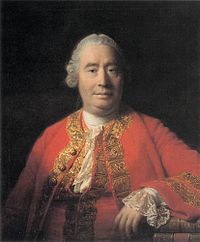
Reflections on : A Treatise on Human Nature by David Hume - Part1 Section1

According to Hume in A Treatise on Human Nature (1740), there are two types of mental activity: "impressions" and "ideas". From Hume's comments, I would describe impressions as including all mental activity that is not an idea. This would include emotions, of course, but also physical and mental perceptions that occur while interacting with the world. For example, if you touch a hot stove, you experience hotness (the impression) independently of the idea of "hot".

Impressions and ideas can be "simple" or "complex". Simple impressions and ideas cannot be broken into component parts of other impressions and ideas. Complex ones can be subdivided into simpler parts.

There is a very close association between simple impressions and ideas - so much so that they may often appear inseparable in the mind.  When I touch the hot stove, I feel the hotness and think "hot" almost simultaneously. 

All simple ideas are preceded and derived from simple impressions. "All our simple ideas in their first appearance are derived from simple impressions, are correspondent to them and which they exactly represent." The impression comes first, then the idea. "We cannot form to ourselves a just idea of the taste of a pine apple, without having actually tasted it."

Complex ideas, composed of simple ideas (and their related impressions), correspond closely to complex impressions. "...all simple ideas and impressions resemble each other; and as the complex are formed from them, we may affirm in general, that these two species of perception are exactly correspondent."

In general, complex ideas can be linked to preceding complex impressions, just as in the simple idea case. However, there are exceptions.  Hume gives an example. Imagine you are shown a pallet of blue shades ranging from dark blue to light blue. One shade in the middle is missing. You can form an idea of what that shade looks like, even though you haven't actually seen it because you can derive the idea from the impressions of the blues on either side of the missing spot. So while there can be complex ideas not preceded by a directly corresponding impression, the idea is derived from a collection of impressions that closely resemble the idea. "Ideas produce the images of themselves in new ideas; but as the first ideas are supposed to be derived from impressions, it still remains true, that all our simple ideas proceed either mediately or immediately, from their correspondent impressions."

From my own analogy, I suggest we can form the idea of a number, say for example "152" because we have a prior impressions/ideas of 1, 2, 3 etc. I also suggest that this same process could be extended to the idea of infinity. I note that this logic seems to support Hume. While we can have the idea of infinity, it still leaves us uneasy mainly because we have never had the experience/impression of actual infinity.

Given this discussion of impressions leading to ideas, and not the reverse, Hume states that there are no innate ideas. They are all derived from our impressions. "...ideas are preceded by other more lively perceptions, from which they are derived, and which they represent."

As I was reading this chapter I kept think of the left brain / right brain theory - particularly that it would be interesting if you substituted those words into Hume's argument. I also thought about the books, Drawing from the Right Side of the Brain by Edwards and The Feeling of What Happens -  Body and Emotion in the Making of Consciousness by Damasio. Finally, I felt that Hume was weighing in on the always popular party question: was mathematics invented or discovered? His comment that there are no innate ideas seems to put him in the "invented" camp. I would disagree with him on that point.

Wednesday, April 20, 2011

The "Cheers" Book Club

We should all have a "Cheers" bar - a place where everyone knows our name - where we are accepted.

We all need - desperately need - to be accepted. This need drives so much of our life -who we hang out with, what we believe, what we do for a living. The need to be accepted drives our very sense of self. If we don't feel accepted, perhaps its because we are not worthy. Maybe there is something wrong with us.

Most of us counter this fear, this sense of worthlessness, by learning to (or at least pretending to) accept the beliefs of those around us. Sometimes learning to accept is healthy (such as Buddhist practice) - sometimes not so healthy. I will adopt my parents' goals so that they will accept me. I will accept a religious doctrine so that my church will welcome me. A professor will accept standard scientific thinking so that she herself will be accepted into the scientific community.

But what happens when you can't accept?

There have been a few points in my life where I felt so out of step with those around me that I began to truly despair. At one point, the split between what I felt was true differed so strongly from the commonly accepted that I began to question my sanity. The worst part of this was that I knew that voicing my skepticism and concerns would only drive me further from those around me.

I was in asset management at the time, and my concerns were about standard investment theory (which related to the nature of risk and returns, which is turn was based on an questionable view of the nature of reality....). Hand in hand with this non-acceptance of standard theory was my questioning of what was marketed as investment expertise. Questioning the theory of experts is roughly the same as questioning the religious doctrine of priests. It was a difficult time for me because I was constantly being measured by a standard I did not accept as valid. Yet my livelihood and my reputation depended on this measurement. [I will add by way of disclaimer that none of this related to actual investment strategy or performance. It related more to the perception of risk and return - pretty subtle point but perception is often more important than reality.]

What I needed was a friend - an outside voice - to tell me that I was OK. That I was not alone. I needed to know that there was a community out there in which I would be accepted.

I found what I needed. It was the book Fooled by Randomness by Nassim Taleb. About a chapter into this book I had a shocking revelation: "This guy is in my head! All of these rants and arguments that I have been keeping bottled up in my head are spewed out all over these pages. How could this be? This guy is crazy - just like me!"

There was so much of this book that truly was a rant - and I loved it. This guy Taleb knew his finance theory - I had read an earlier book by him called Dynamic Hedging. And here he was, someone with real professional credentials - ranting just like me.

I had no doubt that this book would be a failure. It was a ranting, poorly written book that challenged accepted concepts of risk and return in finance and in life. Who would read that?

Much to my surprise, Fooled by Randomness was a success and Taleb wrote an expanded second edition (with less ranting) and then the book The Black Swan. Taleb's success meant something special to me. Not only did I find a kindred spirit in Taleb himself, but there were a lot of other people out there who found his opinions worthwhile. These were my people! I was not alone!

So I found the acceptance I so desperately needed in a book. While I was reading this book a feeling of relief washed over me.  I was under so much stress, and while this book did not change the stress of my daily life, I could face the days a little more easily knowing that I was not alone.

All my life I have found comfort in books. I remember how meaningful the books of Hermann Hesse were to me when I was in high school (Demian, Siddhartha and The Glass Bead Game). And Ayn Rand's passionate cry of self-worth in Atlas Shrugged still echoes in me today.  If nothing else, these books (and others not mentioned) told me that I was not alone. I don't always agree with their views - but as people I respect and accept them - and I hope they would me.

Friday, April 8, 2011

I Stand Corrected

My last blog was me ranting about non-fiction "idea" books burying their key point too deeply - forcing me to read too much of the book before I could tell if it would be worthwhile.  One book I complained about was The Checklist Manifesto by Gawande. I realize now I was wrong.

If you bought a book titled The Checklist Manifesto, what would you think it was about? Checklists - right. And would the book have been in favor of checklists? - Yes! Of course! So there it is. The key idea of this book is that checklists are great. And this key idea wasn't buried deep in the book - it was right there on the book's cover.

The problem is, I assumed there would be more and kept looking, thinking that the golden nugget would be on the very next page. But no - the golden nugget was sitting on the book cover and I had just passed right by it. It turns out that the rest of the book was about medical and aviation stories where lives were saved through the development and use of checklists.

Part of me wants to start a new rant on people writing books based on one idea that could be said in 3 words: "Checklists are great". But just maybe there is something more to this idea and it deserves more than 3 words - even if it is simple.

I was tutoring a student in statistics last semester. He was an engineer and plenty smart, but he was struggling in his class. The exams involved word problems and were quite confusing for the uninitiated. After our sessions, he ended up doing well in the class and I think I really helped him. I think my best advice to him on the subject was this - I told him to go through this process on every exam problem: 1) Determine what kind of problem it is. You do this by looking at the data itself and looking for certain key words in the question. 2) Go to the spot in the software that addresses that type of problem - he should already have mapped out the software to know where to go for each type of question.  3) See what information the software asks for and see if it fits the data provided. 4) Assuming that is a yes, go to a prepared list of things the professor will look for to get full credit.

I know from talking to several students in the class that they study and learn the material, but during the exam, they get confused by the word problems and end up wasting most of the exam time wondering what to do or going down wrong paths. They end up not being able to finish the exam in time. My method takes about 3 minutes - if the person is prepared ahead of time - and should allow a student to finish the exam in about half the time provided.

The secret to my method was a checklist. Not that I thought of it as a checklist at the time, but that is what it was. I thought of it more as a decision tree, which is just an enhanced checklist.

All of this makes me wonder - where else could I use checklists? And why don't I use them more often? What kind of problems can be addressed with checklists? Do some people internalize checklists quickly and does this give them a huge boost in productivity and learning? (My guess is yes on that one) This sounds like the subject of a new blog.

Thursday, March 31, 2011

Pet Peave on Books

I read a lot of non-fiction books - typically several at the same time. Some of these books never get finished and some never understood. But I like having a constant stream of new ideas and perspectives.

One thing I have noticed - and it bothers me - is that most mass-market non-fiction books have only one core idea and the entire rest of the book is fluff around that idea. The better version of these books have their core idea placed near the front, and then repeat it in different ways for the rest of the book. With these books, as long as the idea is neat, you get the payoff early and you can either appreciate the repetition for the rest of the book, or you can stop reading and still feel like the book was worthwhile.

Unfortunately, I seem to have stumbled across several "idea" based books that start the book with fluff and bury the idea somewhere nearer the middle or the end. With these books, I'm left to wonder when and if the idea will ever show up and is there any reason to keep reading. These books often end up sitting buried under something in my car or beside my bed with a dog-eared page about a third of the way through.

One such book is Why Beauty is Truth - A History of Symmetry by Ian Stewart. I am now about 60 pages into this and I'm really starting to wonder when this guy will say something interesting. Clearly the book is about symmetry and beauty and math - it says that on the cover. But all I have read so far are seemingly pointless stories about ancient mathematicians. Hopefully these stories will tie into something eventually, but I may not make it that far.

Another book is The Checklist Manifesto - How to Get Things Done Right by Atul Gawande. I bought this book partly due to the great recommendations on the book cover - probably not a good idea.  I have read the first 35 pages and so far the book is a waste of time. All the book has said in 35 pages is the super-obvious "the world is a complex place".

So when do I give up on these books? For novels I have a rule of thumb that says:  if I get half way through and I don't care about the characters or what happens next, I say it is OK to stop reading. What about these nonfiction books? Does the same half-way rule apply?

This topic was probably not worth a blog - but these books are ticking me off.

Tuesday, March 22, 2011

Wrong Steps

When I was an early teenager, I remember I had a brief flirtation with the idea of becoming a geologist. I quickly gave up on this idea when I decided that nothing could be more boring than thinking about a bunch of static rocks. Plus, I knew a geologist and he seemed pretty boring to me.
I am now starting to think that giving up on geology may have been a mistake.

I think my idea that rocks are static was wrong. Its all a matter of perspective. Sure rocks may look like they don't change or move, but that is because I am measuring them in terms of my own short human perspective. If the earth is more than 4 billion years old, then that is plenty of time for a rocks to do a lot of cool stuff. Plus - as recent events in Japan show, occasionally rocks move a lot, even in our time frame.
I sometimes think that if rocks were sentient beings, their sense of time would be so long that we would never recognize them as sentient, and conversely, the rocks would never recognize us as sentient. They would say, "How could anything with such a short lifespan develop consciousnesses?"

But the real reason I'm starting to think I wrote geology off too soon is that I now keep finding that a lot of geologists think interesting things that don't strictly deal with rocks. I'm sure I mentioned before about geologists modeling earthquakes with networks and power laws (Pareto distributions) [cool stuff!]. I have also mentioned the book Why Stock Markets Crash by Sornette - a professor of geophysics [financial cool stuff]

Today I went through a forgotten corner of my bookshelf and I stumbled upon a book I bought many years ago. It is called Chaos Theory Tamed by Garrett Williams. The great thing about this book is that while it goes into a lot of the math of chaos theory, it tries to teach the theory along the way, not just present it. The writer really seems interested in sharing the what he thinks is a cool subject with his readers. And low and behold, they guy was a retired geologist/hydrologist.

When I got into finance, I figured I had stumbled into an intellectual nirvana. I now see financial theory as hidebound and static, especially compared to what I am reading by geologists. I wonder if it is because financial theory is really geared around making money today - or tomorrow - and the fact that given its short time perspective it is bombarded by too much information. Geologist on the other hand take a long view.

Tuesday, February 15, 2011

A Weird Cosmology - Part 7.2 - The Question

[I wrote some of this post below a couple of years ago as part of a larger piece name "The Ultimate Question"]

In Douglas Adams’ book, The Hitchhiker’s Guide to the Galaxy, a story is told of an extra-terrestrial species that devoted itself over many millennia to finding “the ultimate answer”. After several failed attempts, the species came upon a method. To find the answer, it would manufacture a super colossal computer - a computer so complex that it would incorporate biological and geological components. Even with its enormous size and complexity, this super colossal computer would take several millennia to come up with the answer. The super colossal computer took the form of a planet, and the name of this planet was “Earth”.

The computer known as planet Earth delivered the ultimate answer roughly 1000 years ago. (Since that time, at least until very recently, earth just coasted along.) The alien species awaited the ultimate answer with great anticipation and reverence. On the fateful day of the answer’s unveiling  - a day of fanfare and ritual  - the super colossal computer known as Earth finally spoke. And the ultimate answer was : “forty-seven”.   After recovering from shock, the priests and scientists of the species asked - “Forty-seven? What does that mean?” “What does ‘forty-seven’ answer?” The computer responded , “Oh, so now you want the ultimate question. I wasn’t built to find the ultimate question. To find out that you will need to build a much larger computer”. [I paraphrased this from the book]

The species never did find out what the ultimate question was. A few years later it got caught up in some intergalactic trouble and died out.  It really is a shame.

Douglas Adams moves on with his story, leaving us with nagging questions:  What could the ultimate question be? How could a species devote so much time and energy trying to find an answer without knowing the question?  And if it took a planet sized computer many millennia to come up with an answer like “47”, just how big of a computer would be required to come up with the ultimate question?

I love this story - and as the years pass I love it for different reasons. To me now, the story makes a  point in "My Weird Cosmology". And that is: the Question is far more important then the answer. The Question is the creative force of the universe - just as in The Hitchhikers Guide where the earth was created to answer a question - I believe that our reality may "arise" in response to the Question.

I am obviously not talking about a literal question. So stay with me here. Imagine you are engrossed in an activity - enthralled. Perhaps you are reading a great book on a new topic you are interested in, or listening to a lecture. All of a sudden, an idea, a wonderment, arises in your mind.  Connections start to form, ideas flit back and forth. Its not in the front of your mind yet, but its there behind the scenes. The actual question hasn't formed yet, nor the answers - but its there - or almost there. And in this moment order is being formed from chaos.  It is a sacred moment of creation. OK I know a physical object wasn't created, but something was created.

I once read a story by the fantasy writer Michal Moorcock  where a hero made his way to the castle at the edge of reality. He looked out over the formless swirling chaos at the edge of reality - and in that moment - his presence - his life force - gave form to the chaos and reality was extended.  I think about the Question in a similar way. Reality arises from the Question. But the beauty of the Question is that it is not the answer. It merges order and chaos to create life. Chaos survives, order survives - it is life. 

Why do I use the Question as my creative force?  Hard to say in words. When an idea forms to me, as part question and part answer, it comes with power, energy, an almost physical force. I sense it as a force. Along with it, it is a source of wonderment - a joy. And in my way of thinking - there are no absolute answers - to anything. So in this Weird Cosmology - the Question reigns supreme.

For those of you who feel my weird cosmology so far is not weird at all - maybe now you will change your mind.

Monday, January 24, 2011

Concentration

How long can you concentrate? An hour? Two hours? Or maybe only for a minute or two?

I'm starting to think this little question and the whole subject of concentration is important - or if not important, at least interesting, [or maybe just interesting to me. ok maybe its not that big a deal - never mind].


[Damn!!  I wanted to write this simply an clearly but my internal chatter got in the way. F___, what an idiot! You'd think I could stay focused for at least 5 minutes - but no! I trailed off into this cesspool of idea / counteridea/ self criticism/ self justification...]

That little real life episode is part of my internal chatter which is with me always. I call it my monkey-brain - and it SUCKS! It poisons almost everything. Sometimes I am aware of it happening, but most of the time it takes me over completely and I find a half hour or a half day has passed and all I have done is have some internal incoherent conversation about [who knows what].

What joy it must be not to have to listen to my monkey brain!  That is why I think concentration is important. I am going to define concentration as "non-monkey-brain-thinking". It is focus/thinking devoid of the internal chatter of emotional justification/criticism [the monkey brain].

[to be continued and edited]

Tuesday, January 11, 2011

"Its the end of the world as we know it, and I feel fine." [R.E.M.]

I am starting to think that we humans have a secret desire for the world to end. 

Just think about it: If the world ended there would be no more suffering, no more hunger, jealousy - no more hate groups. You wouldn’t have to worry about disappointing anyone, not being rich enough, slim enough.... Sounds like a good deal!

Furthermore, depending on exactly how the world ends, you can feel justified in your beliefs that those damn Muslims or Capitalists or [substitute your favorite person to blame] were probably the cause. The feeling of moral justification would be worth it. “I knew those bastards would kill us all”. Sweet!

And best of all, if the world ended, no one could blame you for any of this. “Hey I can’t come in to work today - the world is ending.”  Or, “I thought about committing suicide, but that would be wrong. But if the world ends - not my fault.”

I have probably suspected the truth in this “end of the world” theory for a long while, but it recently became clearer to me after I read a book on the Apostle Paul. [ Paul by E.P Sanders ].

Paul was perhaps the most important character in early Christianity (first century CE) - maybe even more important than Jesus himself. It was Paul who popularized Christianity among the non-Jews. [Ok not just Paul - but he gets all the credit] He went around setting up churches and spreading the word of God as told to him in a vision. Paul spoke with authority independent of Jesus’s own teaching [he never met the living Jesus] since he had a direct pipeline to God.

One of Paul’s big selling points - or at least one of his driving beliefs - was that the world was about to end and that people needed to convert now or it might be too late. Paul seems to have originally believed the world would end during his lifetime but as time went on, that was amended to “really soon” and [I suspect] the sooner the better.

But it wasn’t just Paul spreading this end of the world scenario. There were a lot of other religions popping up at the time and many of them predicted the imminent end of the world. Apparently it was a big selling point for new religions at the time.

At first, it seemed strange to hear that so many in the early Roman empire were so fixated on the world ending. [I have since read reasonable explanations (plagues, Parthians etc) and the whole subject sounds like a great sociology topic. ] But then I realized that it wasn’t just the Romans of the first century CE who were fixed on the world ending. The fact that the world was about to end has been a justification for religious fervor ever since.

My theory is that this is not isolated to Christianity or religion in general. It is a basic human desire/need that religions address. Buddha addressed it directly. His "first noble truth" is that life is suffering, and his teachings address how to end suffering. He doesn’t promote the “end of the world” scenario - but it is that the human condition is one of suffering and suffering should/can end.

And its not just in religion. Look at popular culture. There are movies every year where some asteroid is about to hit the earth, or some plague turns 99% of the world into zombies, or there is an alien invasion. Isn’t there a popular belief that the Mayan’s predicted the world will end in 2012? These are all playing to our secret desire for it all to end. And the politics of fear .... don’t get me started.

I was watching a movie the other day and one of the characters was ranting to himself and said:  “I wish this were all over”.  That sounded so familiar.

I don’t want to come across morbid or that I sit around actively wishing for the end of the world. But I do believe that Buddha may be onto something and that we all have a desire for suffering to end. And that this desire to end suffering takes many odd shapes throughout human history and culture.

The easiest way for most to us to imagine the end of suffering is for all of this to simply end. And we pay good money on books, movies, churches and politics that play on that wish.  But we typically keep the wish itself a secret.

Monday, December 20, 2010

A Weird Cosmology - Part 1.1 - TIME

I intend to start wandering into a weird area called “what I think”. In so doing I hope to lay out perhaps a different way to see reality. I would expect that some people might find my thoughts: stupid, intellectual puffery, irrelevant, emotional, immoral, naive.... I have no idea. I don’t pretend that this represents a cohesive system of thought or that this represents latest scientific thinking. It doesn’t.  I believe that rationality as we define it in western culture is way overblown in importance - so if I am accused of being irrational - so be it.

What I am going to say is nonetheless an honest attempt to put down what I think. It is simply a theory of the nature of reality - and I am cool with that. All good theories are meant to be disproven anyway. But for now, its my working theory.

The first and perhaps gateway concept is: time isn’t what we think. We think of time flowing from the past to the future, and that we currently exist “now”. This is the “arrow of time” - it goes ever forward and never backwards.

Except that it doesn’t. Time isn’t an arrow - its closer to a string, or path. It exists always at once and what we think we experience is simply a point on that string. That point on the string, which we consider to be “now”, will exist forever, just as will all the other points on the string. Even though I say “forever”, in this view of time, the idea of forever does not exist. All time exists concurrently such that the only time is forever now. But again, there is no concept of forever.

One way to think of this is that time is simply another dimension, but one in which we as humans can only see at one point.  But otherwise its just another dimension. And does it just extend in one direction - like a string or line, or does it extend in all directions.? I think: all directions.

Strangely enough, my view of time is at least partly supported by the seeming opposite camps of science and religion. From the scientific side, the standard concept of time has been under attack for decades. To see a sample, look at the Wikipedia link to Eternalism  or this excellent site on the Arrow of Time or this link to a Scientific American article That Mysterious Flow by Paul Davis. I don’t want to go into all this scientific theory because there is a massive amount written on this out there and I understand very little of it. But if you want to explore the scientific side of the issue there is plenty to find.

From a religious standpoint, the idea of an omniscient god (God?) has always incorporated a similar view of time. If an omniscient god knows all points of the past, present and future in infinite detail, then they all exist concurrently. Our existence represents a time line and all points are equal.

If time is as I suppose, then why do we experience it like an arrow? Well I ask: If you experienced it any other way, would you be able to function in what we think of as reality? Would you be declared insane?  - no let me change that:  you would be insane! Or alternately you might not be considered conscious.

And there it is:  consciousness as we define consciousness depends on a particular perception of time. In fact, I would argue that consciousness could be defined as the subjective awareness of the passage of time. We see time as an arrow because that is a prerequisite for human consciousness. If we saw it in any other way, we would not be humans.  As a expansion to this thought, if something were to experience time in a different way, we would probably not recognize it as conscious.

Well that is a taste of my weird cosmology. I hope to continue it at a later time.

Thursday, December 16, 2010

Intellectual Disclaimer

Many of the ideas I express in this blog are strictly my own, but when it comes to networks and power laws, many of the ideas come from others. As an introduction to some of these thoughts I recommend the following books:

Ubiquity by Buchanan  - this is the best introduction to the universality of networks and power law concepts
Linked by Barabasi - this is a good discussion of network growth and structure
Why Stock Markets Crash by Sornette - this is a quantitative discussion on network simulation of markets
Fooled by Randomness and The Black Swan by Taleb  - Not for the timid but I recommend anything by Taleb - more than anything, these are works of philosophy and epistemology
The Misbehavior of Markets by Mandelbrot - an attack on traditional market analysis by one of the greats of chaos theory
The Tipping Point by Gladwell  - This was done before much of the current theory was thought about - but it explores the same phenomenon as Linked

Anger Management

In response to David's excellent comment on Capitalism at the Brink, regarding the justifiable anger people have about the financial crisis:  I agree with almost everything you said.


Anger is a natural reaction. Heck - I'm angry about it. I have particular people in mind when I think of attitudes that "led" to this - and when I think of them, I get angry.  Unfortunately, I think my own anger gets mixed into my blog post - but in a weird way - I'm angry at my own anger.

Intellectually, I think the search for causes and villains is in at least some sense unfounded. What happened in the markets is like an earthquake, or avalanche, or like a panic in a crowded room. It is a natural byproduct of the physical and social structure which developed so successfully over the last 40 years. As we drove our economy to more efficiency, less redundancy, and fired anyone who didn't produce immediate results, we created a very successful economy, but also one that was reaching criticality. Was it inevitable that it would happen when it did and in that particular way - no. But it was inevitable it would happen sometime and in some way and when it did - it was inevitable that we would all be angry.

There was a  massive inflow of liquidity/financing made available over the last 30 years and it was this liquidity flow which ultimately stopped. But it was also this massive liquidity flow which led to the stock market and real estate rally over the same time. [And at least in part, these financial innovations were a response to the establishment of ERISA and pension plans in the 80's. Pension plans needed something new to invest in, and our capitalist system created it.] The same phenomenon that led to the economic success of which we are so proud as a nation was both the cause of and result of the processes and practices that blew up.

I am proposing that this crash - and all such crashes - are natural and inevitable byproducts of dynamic "living" systems. If you look hard enough, you may be able to find a triggering event of such a crash, but most likely, every major event was itself caused by a series of smaller and smaller inconspicuous triggering events. Pareto theorized that diverse systems of society and economies can result in a particular and relatively stable pattern of wealth distributions. I'm saying the same thing about how such systems behave over time.

I also believe that a good paradigm for thinking of such a living system is that of a dynamic network.

We see networks everywhere - in a wide range of natural and man made phenomenon. Networks occur naturally - simply as a response to things interacting with with their environment. We see these networks when look out the window at our ecosystem, when we have peaceful relationships with our neighbors, when we see our stocks rally and fall, when we turn on the power to our home. They can lead to amazingly successful growth (Google for example) and equally devastating failures. When things go our way - we think of them as natural and normal. When capitalism "worked" it was because of its inherent superiority and the work ethic of the American people. When it fails - lets find the culprit and string him up.

I also believe that networks display a signature - or fingerprint in their behavior. This signature is the power law distribution, such as the Pareto distribution.

So it is in this context I find the crisis so absolutely fascinating - so cool!  But at the same time -  Yes - those b____s on Wall Street are getting huge bonuses because We bailed them out. I just wish I weren't so angry about it.

[Note that the 80/20 rule is an example of a Pareto distribution - there can be any number of actual parameters - and the Pareto Distribution is just an example of a power law distribution - so when I say networks exhibit power law distributions - I don't mean they all have 80/20 Pareto distributions. Its just that the 80/20 rule is known and hopefully illustrates the point]