Many of the ideas I express in this blog are strictly my own, but when it comes to networks and power laws, many of the ideas come from others. As an introduction to some of these thoughts I recommend the following books:
Ubiquity by Buchanan - this is the best introduction to the universality of networks and power law concepts
Linked by Barabasi - this is a good discussion of network growth and structure
Why Stock Markets Crash by Sornette - this is a quantitative discussion on network simulation of markets
Fooled by Randomness and The Black Swan by Taleb - Not for the timid but I recommend anything by Taleb - more than anything, these are works of philosophy and epistemology
The Misbehavior of Markets by Mandelbrot - an attack on traditional market analysis by one of the greats of chaos theory
The Tipping Point by Gladwell - This was done before much of the current theory was thought about - but it explores the same phenomenon as Linked
Showing posts with label Books. Show all posts
Showing posts with label Books. Show all posts
Thursday, December 16, 2010

Sunday, July 4, 2010
Moses and Monotheism - by Sigmund Freud Part 2

Part 2 of this book assumes that Moses was an Egyptian and explains how an Egyptian could come to be the founder of the Jewish religion. The ancient Egyptian religion was polytheistic and very concerned with death and the afterlife, while the Jewish religion was rigidly monotheistic and does not speak of the afterlife. So how could an Egyptian found the Jewish religion?
The answer is that for a short period, perhaps 17 years, an Egyptian Pharaoh established a new religion that was remarkably similar to the one later adopted by the Jews. In roughly 1330 BC Pharaoh Akhenaten (or Ikhnaton) established a new monotheistic religion that worshiped a moral, just sun god, Aton (Aten), and deemphasized the role of death and afterlife.
Freud speculates that this new religion based on the worship of Aton later became the core of the Jewish religion. He also points out that circumcision was practiced by the Egyptians long before adopted by the Jews and that the Egyptians considered it a sign of distinction from the barbarians elsewhere. It was a mark of cultural superiority - and as such would have been adopted by Moses.
Exodus
Moses was probably a member of Akhenaten's household, or part of the nobility that had accepted this new monotheistic religion. After Akhenaten was overthrown, the old religions were reestablished. Moses gathered ("chose") a disaffected portion of the population, the Jews, and left Egypt to establish a new state where the religion of Aton could be practiced. Moses would have just left Egypt, without the need of miracles, because following the overthrow of the Pharoah, the country was in state of turmoil, with no central leader.
To make a long story short, the refugees went east and eventually met up with a another tribe, the Midianites, who were probably kin, that lived in the area of Qades. Moses died somewhere along the way - proabably killed by the refugees themselves. His teachings were kept alive by his immediate family and followers, later called the Levites.
The Midianties worshipped a different god, Jahve (Jehovah) who was a volcano/fire/lightening/mountain god. After a few generations (Freud speculates two generations) these two religions merged into one. Many of the names and forms of the Midiante religion were kept, but the substance was primarily that of the Egyptian Moses. This new blended religion contained miracles and other inventions designed to create one unified and glorious story that gave credit to both cultures.
Dualism
I was most interested in this last part of Freud's account. I have always felt that the Bible described two very different gods, one of light which is universal, indescribable and concerned with living a moral and just life. The other god was very human in appearance and his passions - and particularly vengeful and jealous.
Frued's account would explain this dualism. In reference to the Mediante god, he states, "The god Jahve ... was probably in no way a remarkable being. A rude, narrow-minded local god, violent and bloodthirsty, he had promised his adherents to give them 'a land flowing with milk and honey' and encouraged them to rid the country of its present inhabitants 'with the edge of the sword.'" This god was probably not even monotheistic, but just one more local god.
The god of the Egyptian Moses however was an entirely different nature - and Freud credits the Jewish people that it is from this version that they draw their inspiration.
Saturday, June 26, 2010
Moses and Monotheism - by Sigmund Freud Part 1
This book was first published in 1939. My Mom just gave me a copy and I find it interesting . Moses was a central figure in three of the world's "great" religions - Judaism, Christianity and Islam. I will give a thumbnail sketch of the first of the three chapters.
Moses an Egyptian
The Birth of Moses - Traditional Approach
By way of background, Wikipedia gives the following text concerning the birth of Moses:
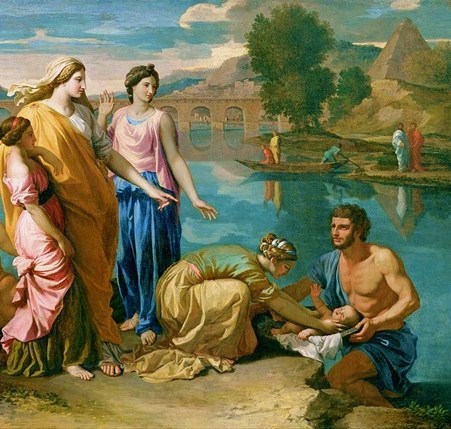 In the Exodus account, the birth of Moses occurred at a time when an unnamed Egyptian Pharaoh had commanded that all male Hebrew children born be killed by drowning in the river Nile. Jochebed, the wife of the Levite Amram, bore a son and kept him concealed for three months.[6][8][9] When she could keep him hidden no longer, rather than deliver him to be killed, she set him adrift on the Nile River in a small craft of bulrushes coated in pitch.[8] Moses' sister Miriam observed the progress of the tiny boat until it reached a place where Pharaoh's daughter (Bithiah[6],Thermuthis [10]) was bathing with her handmaidens. It is said that she spotted the baby in the basket and had her handmaiden fetch it for her. Miriam came forward and asked Pharaoh's daughter if she would like a Hebrew woman to nurse the baby.[6] Thereafter, Jochebed was employed as the child's nurse. He grew up and was brought to Pharaoh's daughter and became her son and a younger brother to the future Pharaoh of Egypt. Moses would not be able to become Pharaoh because he was not the 'blood' son of Bithiah, and he was the youngest.
Exodus and Flavius Josephus do not mention whether this daughter of Pharaoh was an only child or, if she was not an only child, whether she was an eldest child or an eldest daughter. Nor do they mention whether Thermuthis later had other natural or adopted children. If Rameses II is the Pharaoh of the Oppression, as was traditionally thought, identifying her would be extremely difficult as Rameses II is thought to have fathered over a hundred children. The daughter of Pharaoh named him Mosheh, similar to the Hebrew word mashah, "to draw out".
In the Moses story related by the Quran, Jochebed is commanded by God to place Moses in an ark and cast him on the waters of the Nile, thus abandoning him completely to God's protection. Pharaoh's wife Asiya, not his daughter, found Moses floating in the waters of the Nile. She convinced Pharaoh to keep him as their son because they were not blessed with any children. (source Wikipedia)
Freud's Approach: Moses an Egyptian
Freud's approach was that Moses was not a Jew, but an Egyptian - and he supports this approach with three arguments:
1) The name "Moses" does not fit properly into the story. It was supposedly given to him by the Egyptian princess who found him and is usually attributed to being from Hebrew where it is written as Mosche. Freud quotes from Judisches Lexikon , "The Biblical interpretation of the name: 'He that is drawn out of the water' is folk etymology; the active Hebrew form itself of the name (Mosche can best mean only "the drawer out" [Moses as a baby was drawn out of the water - he wasn't the "drawer" - JSM] ) cannot be reconciled with this solution." Freud continues "This argument can be supported by two further reflections; first that it is nonsensical to credit an Egyptian princess with a knowledge of Hebrew etymology, and, secondly that the water from which the child was drawn was most probably not the water of the Nile."
2) Instead of being from Hebrew, the name Moses is most likely related to the word "mose" in Egyptian, meaning "child". It is usually preceded by the fathers name. We see a similar pattern in the names of Egyptian kings such as Ramses (Ra-mose or child of Ra) or Thotmes (Thut-mose - child of Thut).
3) Freud's third argument relies on a concept he refers to as the "average myth" and it relates to the "fact" that most peoples develop myths around their most important heroes, kings religious figures etc.. This is a very interesting idea and is very similar to those of Joseph Campbell in his writings on mythology. I will note the Freud does not take credit for this idea.
The Average Myth
In this case, Moses of myth was born of lowly Jewish parents and was adopted into a noble household. The Egyptian family (the second family in the myth) was the real family. Moses was an Egyptian from the very start and that the part about the Jewish mother was a myth created to support his later stature in the Jewish culture.
Freud concludes the first section conceding that the evidence of Mose's Egyptian birth is far from proof - but that the entire story is shrouded in religious mystery. He certainly believes that it is a reasonable argument - and if it is true, it sheds a completely different light on the story of Moses and the Jewish faith. His next chapter is If Moses Was an Egyptian.
Random Thoughts
I find it interesting that Freud, the father of psychoanalysis, looked into cultural beliefs (the mind of society) as though he were looking into an individual's mind. There is an implied idea that society is a consciousness.
I also find it interesting that Freud, a Jew, would even take on this topic - And he notes in the book that he does so with some reservation. But he did it anyway and it sounds like from the many references he quotes in the book, he wasn't the only one.
Finally, I find it interesting that my Mom, a Christian, would pass this book on to me. But I believe that if faith rests in the heart rather than in religious doctrine, the mind is free to explore.
Moses an Egyptian
The Birth of Moses - Traditional Approach
By way of background, Wikipedia gives the following text concerning the birth of Moses:
Exodus and Flavius Josephus do not mention whether this daughter of Pharaoh was an only child or, if she was not an only child, whether she was an eldest child or an eldest daughter. Nor do they mention whether Thermuthis later had other natural or adopted children. If Rameses II is the Pharaoh of the Oppression, as was traditionally thought, identifying her would be extremely difficult as Rameses II is thought to have fathered over a hundred children. The daughter of Pharaoh named him Mosheh, similar to the Hebrew word mashah, "to draw out".
In the Moses story related by the Quran, Jochebed is commanded by God to place Moses in an ark and cast him on the waters of the Nile, thus abandoning him completely to God's protection. Pharaoh's wife Asiya, not his daughter, found Moses floating in the waters of the Nile. She convinced Pharaoh to keep him as their son because they were not blessed with any children. (source Wikipedia)
Freud's Approach: Moses an Egyptian
Freud's approach was that Moses was not a Jew, but an Egyptian - and he supports this approach with three arguments:
1) The name "Moses" does not fit properly into the story. It was supposedly given to him by the Egyptian princess who found him and is usually attributed to being from Hebrew where it is written as Mosche. Freud quotes from Judisches Lexikon , "The Biblical interpretation of the name: 'He that is drawn out of the water' is folk etymology; the active Hebrew form itself of the name (Mosche can best mean only "the drawer out" [Moses as a baby was drawn out of the water - he wasn't the "drawer" - JSM] ) cannot be reconciled with this solution." Freud continues "This argument can be supported by two further reflections; first that it is nonsensical to credit an Egyptian princess with a knowledge of Hebrew etymology, and, secondly that the water from which the child was drawn was most probably not the water of the Nile."
2) Instead of being from Hebrew, the name Moses is most likely related to the word "mose" in Egyptian, meaning "child". It is usually preceded by the fathers name. We see a similar pattern in the names of Egyptian kings such as Ramses (Ra-mose or child of Ra) or Thotmes (Thut-mose - child of Thut).
3) Freud's third argument relies on a concept he refers to as the "average myth" and it relates to the "fact" that most peoples develop myths around their most important heroes, kings religious figures etc.. This is a very interesting idea and is very similar to those of Joseph Campbell in his writings on mythology. I will note the Freud does not take credit for this idea.
The Average Myth
- the hero's true parents are from the highest station (such as a king)
- The hero's conception is hindered by difficulties such as abstinence or temporary sterility [I think virgin birth qualifies here - but that is a different story]. During the pregnancy an oracle or dream warns the father of danger related to the child's birth
- The father figure gives the order that the baby be killed or exposed to extreme danger. In most cases the baby is usually placed in a casket and delivered to the waves.
- The child is saved by animals or common people and suckled by a woman of humble birth.
- When grown, the hero rediscovers his noble heritage, has strange adventures, takes vengeance on his father and attains fame with his people.
In this case, Moses of myth was born of lowly Jewish parents and was adopted into a noble household. The Egyptian family (the second family in the myth) was the real family. Moses was an Egyptian from the very start and that the part about the Jewish mother was a myth created to support his later stature in the Jewish culture.
Freud concludes the first section conceding that the evidence of Mose's Egyptian birth is far from proof - but that the entire story is shrouded in religious mystery. He certainly believes that it is a reasonable argument - and if it is true, it sheds a completely different light on the story of Moses and the Jewish faith. His next chapter is If Moses Was an Egyptian.
Random Thoughts
I find it interesting that Freud, the father of psychoanalysis, looked into cultural beliefs (the mind of society) as though he were looking into an individual's mind. There is an implied idea that society is a consciousness.
I also find it interesting that Freud, a Jew, would even take on this topic - And he notes in the book that he does so with some reservation. But he did it anyway and it sounds like from the many references he quotes in the book, he wasn't the only one.
Finally, I find it interesting that my Mom, a Christian, would pass this book on to me. But I believe that if faith rests in the heart rather than in religious doctrine, the mind is free to explore.
Thursday, June 10, 2010
"Too Big to Fail" a book by Andrew Ross Sorkin - A Review and Comments
I just finished Too Big to Fail and found it enjoyable, but not so much that I would definitely recommend it. I think I enjoyed it more than many people would because I was in the financial industry, did business with all of the firms mentioned in the book and I was familiar with a few of the people.
 The book covers the financial crisis from the failure of Bear Stearns in early 2008 through the failure of Lehman and AIG and it ends with the introduction of the TARP program in late 2008. There is a little back story on the career of a few of the major people such as Bernanke, Paulson, Geithner and Fuld (at Lehman) but most of the book is structured as sequential snapshots of conversations and meetings. The pacing of these snapshots is leasurely at first but by the end is frenetic as the book switches back and forth in minute to minute conversations as people desperately try to stop a immanent economic catastrophe. I found this pacing annoying because I had a hard time following the timeline. Early on, there could be months between snapshots but by the end they were minute to minute - and it wasn’t clear just when things were happening. But this escalating pacing did provide what little sense of story the book had.
This book is a documentary - not a story. It covers a lot conversations among a long list of people most of us have never heard of and in whom we probably have no interest. And it covers events which, if viewed in isolation, without proper context, have little meaning. So while I say this book is a documentary - it is arguably not a good documentary because a good documentary should give the reader a sense of context as to what led up to the events, what sort of environment they took place in and why they were important.
That said, I found the book interesting - but I have a painfully intimate knowledge of the institutional money flows that keep businesses afloat and the economy running. So I already had a sense of context. I imagine that most people who follow the markets will also have enough sense of context to enjoy the book - but perhaps may not understand the sense of imminent catastrophe that drove the actors.
I have a few takeaways:
1) People were amazingly naive for an amazingly long time. Keep in mind that the institutional money markets had the equivalent of a heart attack in the late summer of 2007 and never recovered. This was more than 6 months before Bear Stearns fell and more than a year before Lehman failed. The institutional money market is like the blood flowing through the body of the economy. It is taken for granted, but if it stops flowing, it isn’t long before the major organs fail. The body in this case had enough money in its system to last 6 months, then the organs started to fail. Concentrating on poor asset quality and the mortgage market is like a Doctor concentrating on a broken arm or perhaps even cancer. Bad, but certainly not immediately fatal. The immediate problem was that patient was dying from lack of blood flowing through the body.
2) People were so fixated on hedge funds selling short financial stocks and fraud in the mortgage industry that they seem to have ignored the far more important fact that money - the blood of the system, had stopped flowing. As evidence of this, the book relays many conversations where CEOs are ranting about short sellers driving down their stock price and as though that was the real problem. And yet none of the companies were at risk of collapse because their stock was going down. The companies were collapsing because they were running out of money - as in cash. And even while they were trying to sell any and every asset in the company to pay off the next bill coming due, they ranted about short sellers. Financial companies always have big bills coming due - they are 70% to 99% financed by debt. They don’t need to pay off the stockholders. They need to pay off their debt coming due.
3) It seems that Goldman Sachs alumni are everywhere. The book never pointed to this being a real problem, but I can sure see that when it looked like “even Goldman Sachs” would fail within the week, then the line in the sand was drawn right then and there. No one could imagine a world without Goldman Sachs.
4) Senior executives didn’t seem to understand their own business. [no surprise] This was particularly clear at AIG when they woke up to the fact one day that Securities Lending was going to cost them a boatload of money and it sounded like they didn’t even know what Securities Lending was. The whole “short-sellers” controversy that CEO’s ranted about was just an indication they didn’t realize the real issue. The regulators weren’t any better. They ignored the fact that AIG was insolvent for months before it finally fell. They were looking at Lehman when “surprise surprise” AIG collapses. All of these events followed a fairly clear trajectory and the regulators should have been able to connect the dots.
5) Even when the ship is sinking - people still think “will my deck chair be comfortable”. CEO’s cared about short-sellers because they drove down stock prices and that is where the CEO’s had their wealth. Never mind that the company is dying - how is the stock doing. Also, even in the final dying moments of the firms, people still stalled and delayed so they would have a great job in the new company.
6) In the final days before TARP, Geithner ran the show - he was the real deal maker. He sounds like an egomaniac and someone eager to make the “necessary” decision. Paulson sounds like he was in denial but then “woke up” and made TARP happen. In the book, Bernanke sounds like someone always running a few weeks behind events. Cox at the SEC and Fuld at Lehman were punchlines to a bad joke.
7) My interpretation of the events surrounding the BofA / Merrill combination is that Ken Lewis, the CEO of BofA, was an idiot. Merrill Lynch was failing!! It could have been bought from the Government the very next day for free and with probable Government guarantees attached. But Ken Lewis was so wrapped up in his victory dance that he was buying THE Merrill Lynch at a “cheap” price that he completely missed the fact that THE Merrill Lynch was now worthless. And it doesn’t sound like the Government promised him anything. They were hoping BofA was going to buy Lehman. It sounds like the Government wasn’t even that aware that Merrill was about to fail until it almost did.
8) Although the book was full of egomaniacs, jerks, nice guys and idiots, there were no real “bad guys” and no real “good guys” as related to the crisis. Everyone was just caught up in something they had never experienced before and was responding in their own individual way, usually just looking out for themselves or just trying to get through the day. No one plotted to destroy the world.
9) There was a point where the people in the book, well at least most of the people, seemed to have woken up to the problem. It’s like there was a light switch. First it was “we will not support...” and then it was “oh shit...”
When this “oh shit....” realization finally hit, no one really talked about what “oh shit...” meant. It is pretty clear that at a minimum their “oh shit...” meant that all the investments banks would fail. Morgan Stanley was within days of failure and Goldman Sachs would fail “30 seconds” behind that. Then what? Wachovia Bank was already failing and had to be merged, Citi and Bank of America had major issues. Were they next? Other than the unthinkable event of Goldman Sachs failing, the closest the book came to really descibing the full “oh shit...” scenario is that GE would soon fail. But the book never went farther and it implies that the major players kept their mouth shut on just how bad it could be. I believe they kept their mouth shut because they were truly afraid and they didn’t want to voice their real concerns from fear it would accelerate the problem.
 So I will give my full version of “oh shit...” If allowed to run unchecked, the small amount of money still flowing through the system would have shut down completely. Investors, due to a combination of prudence, legal requirements and due to their own cash needs would be forced to stop investing in anything that wasn’t Government backed. The investment banks would fail within a week - this meant Morgan Stanley and Goldman Sachs. Citi and BofA would have had major funding crisis within days primarily due to their need to fund massive commercial paper programs. The Government would have been forced to step in at some point - though in this scenario, only small depositors would be covered so there would be trillians of dollars lost to investors and large depositors. All other banks would soon face a funding crisis and would be forced to operate with “negative capital”. GE would have been unable to roll its short term-debt within weeks and would be forced into bankruptcy. (actually most of this was already being talked about) All commercial finance companies would fail along with GE. With the collapse of commercial funding, businesses would be forced to liquidate assets and stop their activities. Even companies who didn’t borrow would see their customers disappear. Layoffs would begin in real earnest.
But then it gets really scary. Municipalities would not be able to issue debt and make payrolls. Basic services would gradually be cut back. Pension funds, foundations, universities, health systems would take massive losses across all asset classes, but worse yet, most their cash is invested in short term debt of financial companies which are no longer paying off. Without cash, pension payments and payrolls are missed. In fact all companies put their payroll and working capital cash in banks and money market funds. These companies can’t make payrolls. The courts would be come clogged. The Government would be forced to call out the military to handle a suddenly impoverished under-policed populace. Foreign governments would begin to default... (Greece, Hungary, Egypt, Spain, Iceland, England, Russia...) Let’s just say it gets a lot worse even from here. The world collapses along the same mechanisms that in better times make it work.
I believe this is what really scared the shit out of Paulson and company. He looked over the edge and saw the abyss. What was unthinkable in our normal world, became the all too possible.
So that is the real meaning “Too Big to Fail”. If a failure leads to even the possibility of global financial and social meltdown, then its just too big and can’t be allowed to happen.
10) In school, we are taught to think using the paradigm of a “normal” distribution - the traditional bell curve. If you think of the world as following a normal distribution of events, then no natural failure is truly too big. Bad things can happen, but they aren’t really really bad and eventually everything will return to normal. This is the world view of those who say “let them fail - we will recover”. In this pretend world, truly catastrophic failures can’t happen on their own. So if they do happen, they must be caused by someone doing something massively evil. I would say that this is the base-case view of most people, even those who don’t know what a normal distribution is. It is certainly the view pushed by the media and politicians.
But if you think of a world built using networks (such as a financial system) then the distribution of possible events isn’t normal distributed - it follows a Pareto/power-law distribution. And under this paradigm, events can truly become too too big - where a single event can dramatically affect the entire system. - even destroy it. And under this paradigm, catastrophic events can occur naturally. You can always find scapegoats after the fact, but they are not really the cause.

This book is a documentary - not a story. It covers a lot conversations among a long list of people most of us have never heard of and in whom we probably have no interest. And it covers events which, if viewed in isolation, without proper context, have little meaning. So while I say this book is a documentary - it is arguably not a good documentary because a good documentary should give the reader a sense of context as to what led up to the events, what sort of environment they took place in and why they were important.
That said, I found the book interesting - but I have a painfully intimate knowledge of the institutional money flows that keep businesses afloat and the economy running. So I already had a sense of context. I imagine that most people who follow the markets will also have enough sense of context to enjoy the book - but perhaps may not understand the sense of imminent catastrophe that drove the actors.
I have a few takeaways:
1) People were amazingly naive for an amazingly long time. Keep in mind that the institutional money markets had the equivalent of a heart attack in the late summer of 2007 and never recovered. This was more than 6 months before Bear Stearns fell and more than a year before Lehman failed. The institutional money market is like the blood flowing through the body of the economy. It is taken for granted, but if it stops flowing, it isn’t long before the major organs fail. The body in this case had enough money in its system to last 6 months, then the organs started to fail. Concentrating on poor asset quality and the mortgage market is like a Doctor concentrating on a broken arm or perhaps even cancer. Bad, but certainly not immediately fatal. The immediate problem was that patient was dying from lack of blood flowing through the body.
2) People were so fixated on hedge funds selling short financial stocks and fraud in the mortgage industry that they seem to have ignored the far more important fact that money - the blood of the system, had stopped flowing. As evidence of this, the book relays many conversations where CEOs are ranting about short sellers driving down their stock price and as though that was the real problem. And yet none of the companies were at risk of collapse because their stock was going down. The companies were collapsing because they were running out of money - as in cash. And even while they were trying to sell any and every asset in the company to pay off the next bill coming due, they ranted about short sellers. Financial companies always have big bills coming due - they are 70% to 99% financed by debt. They don’t need to pay off the stockholders. They need to pay off their debt coming due.
3) It seems that Goldman Sachs alumni are everywhere. The book never pointed to this being a real problem, but I can sure see that when it looked like “even Goldman Sachs” would fail within the week, then the line in the sand was drawn right then and there. No one could imagine a world without Goldman Sachs.
4) Senior executives didn’t seem to understand their own business. [no surprise] This was particularly clear at AIG when they woke up to the fact one day that Securities Lending was going to cost them a boatload of money and it sounded like they didn’t even know what Securities Lending was. The whole “short-sellers” controversy that CEO’s ranted about was just an indication they didn’t realize the real issue. The regulators weren’t any better. They ignored the fact that AIG was insolvent for months before it finally fell. They were looking at Lehman when “surprise surprise” AIG collapses. All of these events followed a fairly clear trajectory and the regulators should have been able to connect the dots.
5) Even when the ship is sinking - people still think “will my deck chair be comfortable”. CEO’s cared about short-sellers because they drove down stock prices and that is where the CEO’s had their wealth. Never mind that the company is dying - how is the stock doing. Also, even in the final dying moments of the firms, people still stalled and delayed so they would have a great job in the new company.
6) In the final days before TARP, Geithner ran the show - he was the real deal maker. He sounds like an egomaniac and someone eager to make the “necessary” decision. Paulson sounds like he was in denial but then “woke up” and made TARP happen. In the book, Bernanke sounds like someone always running a few weeks behind events. Cox at the SEC and Fuld at Lehman were punchlines to a bad joke.
7) My interpretation of the events surrounding the BofA / Merrill combination is that Ken Lewis, the CEO of BofA, was an idiot. Merrill Lynch was failing!! It could have been bought from the Government the very next day for free and with probable Government guarantees attached. But Ken Lewis was so wrapped up in his victory dance that he was buying THE Merrill Lynch at a “cheap” price that he completely missed the fact that THE Merrill Lynch was now worthless. And it doesn’t sound like the Government promised him anything. They were hoping BofA was going to buy Lehman. It sounds like the Government wasn’t even that aware that Merrill was about to fail until it almost did.
8) Although the book was full of egomaniacs, jerks, nice guys and idiots, there were no real “bad guys” and no real “good guys” as related to the crisis. Everyone was just caught up in something they had never experienced before and was responding in their own individual way, usually just looking out for themselves or just trying to get through the day. No one plotted to destroy the world.
9) There was a point where the people in the book, well at least most of the people, seemed to have woken up to the problem. It’s like there was a light switch. First it was “we will not support...” and then it was “oh shit...”
When this “oh shit....” realization finally hit, no one really talked about what “oh shit...” meant. It is pretty clear that at a minimum their “oh shit...” meant that all the investments banks would fail. Morgan Stanley was within days of failure and Goldman Sachs would fail “30 seconds” behind that. Then what? Wachovia Bank was already failing and had to be merged, Citi and Bank of America had major issues. Were they next? Other than the unthinkable event of Goldman Sachs failing, the closest the book came to really descibing the full “oh shit...” scenario is that GE would soon fail. But the book never went farther and it implies that the major players kept their mouth shut on just how bad it could be. I believe they kept their mouth shut because they were truly afraid and they didn’t want to voice their real concerns from fear it would accelerate the problem.

But then it gets really scary. Municipalities would not be able to issue debt and make payrolls. Basic services would gradually be cut back. Pension funds, foundations, universities, health systems would take massive losses across all asset classes, but worse yet, most their cash is invested in short term debt of financial companies which are no longer paying off. Without cash, pension payments and payrolls are missed. In fact all companies put their payroll and working capital cash in banks and money market funds. These companies can’t make payrolls. The courts would be come clogged. The Government would be forced to call out the military to handle a suddenly impoverished under-policed populace. Foreign governments would begin to default... (Greece, Hungary, Egypt, Spain, Iceland, England, Russia...) Let’s just say it gets a lot worse even from here. The world collapses along the same mechanisms that in better times make it work.
I believe this is what really scared the shit out of Paulson and company. He looked over the edge and saw the abyss. What was unthinkable in our normal world, became the all too possible.
So that is the real meaning “Too Big to Fail”. If a failure leads to even the possibility of global financial and social meltdown, then its just too big and can’t be allowed to happen.
10) In school, we are taught to think using the paradigm of a “normal” distribution - the traditional bell curve. If you think of the world as following a normal distribution of events, then no natural failure is truly too big. Bad things can happen, but they aren’t really really bad and eventually everything will return to normal. This is the world view of those who say “let them fail - we will recover”. In this pretend world, truly catastrophic failures can’t happen on their own. So if they do happen, they must be caused by someone doing something massively evil. I would say that this is the base-case view of most people, even those who don’t know what a normal distribution is. It is certainly the view pushed by the media and politicians.
But if you think of a world built using networks (such as a financial system) then the distribution of possible events isn’t normal distributed - it follows a Pareto/power-law distribution. And under this paradigm, events can truly become too too big - where a single event can dramatically affect the entire system. - even destroy it. And under this paradigm, catastrophic events can occur naturally. You can always find scapegoats after the fact, but they are not really the cause.
Subscribe to:
Posts (Atom)

 Posts
Posts

