If Moses Was an Egyptian...
Part 2 of this book assumes that Moses was an Egyptian and explains how an Egyptian could come to be the founder of the Jewish religion. The ancient Egyptian religion was polytheistic and very concerned with death and the afterlife, while the Jewish religion was rigidly monotheistic and does not speak of the afterlife. So how could an Egyptian found the Jewish religion?
The answer is that for a short period, perhaps 17 years, an Egyptian Pharaoh established a new religion that was remarkably similar to the one later adopted by the Jews. In roughly 1330 BC Pharaoh Akhenaten (or Ikhnaton) established a new monotheistic religion that worshiped a moral, just sun god, Aton (Aten), and deemphasized the role of death and afterlife.
Freud speculates that this new religion based on the worship of Aton later became the core of the Jewish religion. He also points out that circumcision was practiced by the Egyptians long before adopted by the Jews and that the Egyptians considered it a sign of distinction from the barbarians elsewhere. It was a mark of cultural superiority - and as such would have been adopted by Moses.
Exodus
Moses was probably a member of Akhenaten's household, or part of the nobility that had accepted this new monotheistic religion. After Akhenaten was overthrown, the old religions were reestablished. Moses gathered ("chose") a disaffected portion of the population, the Jews, and left Egypt to establish a new state where the religion of Aton could be practiced. Moses would have just left Egypt, without the need of miracles, because following the overthrow of the Pharoah, the country was in state of turmoil, with no central leader.
To make a long story short, the refugees went east and eventually met up with a another tribe, the Midianites, who were probably kin, that lived in the area of Qades. Moses died somewhere along the way - proabably killed by the refugees themselves. His teachings were kept alive by his immediate family and followers, later called the Levites.
The Midianties worshipped a different god, Jahve (Jehovah) who was a volcano/fire/lightening/mountain god. After a few generations (Freud speculates two generations) these two religions merged into one. Many of the names and forms of the Midiante religion were kept, but the substance was primarily that of the Egyptian Moses. This new blended religion contained miracles and other inventions designed to create one unified and glorious story that gave credit to both cultures.
Dualism
I was most interested in this last part of Freud's account. I have always felt that the Bible described two very different gods, one of light which is universal, indescribable and concerned with living a moral and just life. The other god was very human in appearance and his passions - and particularly vengeful and jealous.
Frued's account would explain this dualism. In reference to the Mediante god, he states, "The god Jahve ... was probably in no way a remarkable being. A rude, narrow-minded local god, violent and bloodthirsty, he had promised his adherents to give them 'a land flowing with milk and honey' and encouraged them to rid the country of its present inhabitants 'with the edge of the sword.'" This god was probably not even monotheistic, but just one more local god.
The god of the Egyptian Moses however was an entirely different nature - and Freud credits the Jewish people that it is from this version that they draw their inspiration.
Showing posts with label History. Show all posts
Sunday, July 4, 2010
Saturday, June 26, 2010
Moses and Monotheism - by Sigmund Freud Part 1
This book was first published in 1939. My Mom just gave me a copy and I find it interesting . Moses was a central figure in three of the world's "great" religions - Judaism, Christianity and Islam. I will give a thumbnail sketch of the first of the three chapters.
Moses an Egyptian
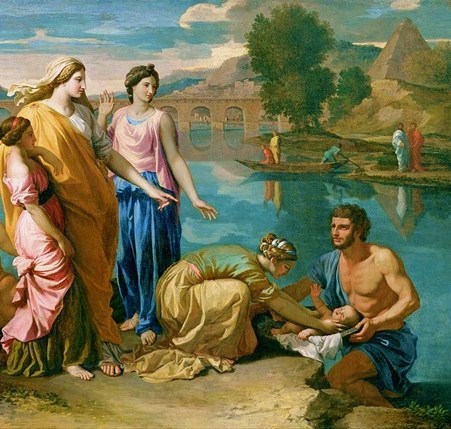
The Birth of Moses - Traditional Approach
By way of background, Wikipedia gives the following text concerning the birth of Moses:
In the Exodus account, the birth of Moses occurred at a time when an unnamed Egyptian Pharaoh had commanded that all male Hebrew children born be killed by drowning in the river Nile. Jochebed, the wife of the Levite Amram, bore a son and kept him concealed for three months.[6][8][9] When she could keep him hidden no longer, rather than deliver him to be killed, she set him adrift on the Nile River in a small craft of bulrushes coated in pitch.[8] Moses' sister Miriam observed the progress of the tiny boat until it reached a place where Pharaoh's daughter (Bithiah[6],Thermuthis [10]) was bathing with her handmaidens. It is said that she spotted the baby in the basket and had her handmaiden fetch it for her. Miriam came forward and asked Pharaoh's daughter if she would like a Hebrew woman to nurse the baby.[6] Thereafter, Jochebed was employed as the child's nurse. He grew up and was brought to Pharaoh's daughter and became her son and a younger brother to the future Pharaoh of Egypt. Moses would not be able to become Pharaoh because he was not the 'blood' son of Bithiah, and he was the youngest.
Exodus and Flavius Josephus do not mention whether this daughter of Pharaoh was an only child or, if she was not an only child, whether she was an eldest child or an eldest daughter. Nor do they mention whether Thermuthis later had other natural or adopted children. If Rameses II is the Pharaoh of the Oppression, as was traditionally thought, identifying her would be extremely difficult as Rameses II is thought to have fathered over a hundred children. The daughter of Pharaoh named him Mosheh, similar to the Hebrew word mashah, "to draw out".
In the Moses story related by the Quran, Jochebed is commanded by God to place Moses in an ark and cast him on the waters of the Nile, thus abandoning him completely to God's protection. Pharaoh's wife Asiya, not his daughter, found Moses floating in the waters of the Nile. She convinced Pharaoh to keep him as their son because they were not blessed with any children. (source Wikipedia)
Freud's Approach: Moses an Egyptian
Freud's approach was that Moses was not a Jew, but an Egyptian - and he supports this approach with three arguments:
1) The name "Moses" does not fit properly into the story. It was supposedly given to him by the Egyptian princess who found him and is usually attributed to being from Hebrew where it is written as Mosche. Freud quotes from Judisches Lexikon , "The Biblical interpretation of the name: 'He that is drawn out of the water' is folk etymology; the active Hebrew form itself of the name (Mosche can best mean only "the drawer out" [Moses as a baby was drawn out of the water - he wasn't the "drawer" - JSM] ) cannot be reconciled with this solution." Freud continues "This argument can be supported by two further reflections; first that it is nonsensical to credit an Egyptian princess with a knowledge of Hebrew etymology, and, secondly that the water from which the child was drawn was most probably not the water of the Nile."
2) Instead of being from Hebrew, the name Moses is most likely related to the word "mose" in Egyptian, meaning "child". It is usually preceded by the fathers name. We see a similar pattern in the names of Egyptian kings such as Ramses (Ra-mose or child of Ra) or Thotmes (Thut-mose - child of Thut).
3) Freud's third argument relies on a concept he refers to as the "average myth" and it relates to the "fact" that most peoples develop myths around their most important heroes, kings religious figures etc.. This is a very interesting idea and is very similar to those of Joseph Campbell in his writings on mythology. I will note the Freud does not take credit for this idea.
The Average Myth
In this case, Moses of myth was born of lowly Jewish parents and was adopted into a noble household. The Egyptian family (the second family in the myth) was the real family. Moses was an Egyptian from the very start and that the part about the Jewish mother was a myth created to support his later stature in the Jewish culture.
Freud concludes the first section conceding that the evidence of Mose's Egyptian birth is far from proof - but that the entire story is shrouded in religious mystery. He certainly believes that it is a reasonable argument - and if it is true, it sheds a completely different light on the story of Moses and the Jewish faith. His next chapter is If Moses Was an Egyptian.
Random Thoughts
I find it interesting that Freud, the father of psychoanalysis, looked into cultural beliefs (the mind of society) as though he were looking into an individual's mind. There is an implied idea that society is a consciousness.
I also find it interesting that Freud, a Jew, would even take on this topic - And he notes in the book that he does so with some reservation. But he did it anyway and it sounds like from the many references he quotes in the book, he wasn't the only one.
Finally, I find it interesting that my Mom, a Christian, would pass this book on to me. But I believe that if faith rests in the heart rather than in religious doctrine, the mind is free to explore.
Moses an Egyptian
The Birth of Moses - Traditional Approach
By way of background, Wikipedia gives the following text concerning the birth of Moses:
In the Exodus account, the birth of Moses occurred at a time when an unnamed Egyptian Pharaoh had commanded that all male Hebrew children born be killed by drowning in the river Nile. Jochebed, the wife of the Levite Amram, bore a son and kept him concealed for three months.[6][8][9] When she could keep him hidden no longer, rather than deliver him to be killed, she set him adrift on the Nile River in a small craft of bulrushes coated in pitch.[8] Moses' sister Miriam observed the progress of the tiny boat until it reached a place where Pharaoh's daughter (Bithiah[6],Thermuthis [10]) was bathing with her handmaidens. It is said that she spotted the baby in the basket and had her handmaiden fetch it for her. Miriam came forward and asked Pharaoh's daughter if she would like a Hebrew woman to nurse the baby.[6] Thereafter, Jochebed was employed as the child's nurse. He grew up and was brought to Pharaoh's daughter and became her son and a younger brother to the future Pharaoh of Egypt. Moses would not be able to become Pharaoh because he was not the 'blood' son of Bithiah, and he was the youngest.
Exodus and Flavius Josephus do not mention whether this daughter of Pharaoh was an only child or, if she was not an only child, whether she was an eldest child or an eldest daughter. Nor do they mention whether Thermuthis later had other natural or adopted children. If Rameses II is the Pharaoh of the Oppression, as was traditionally thought, identifying her would be extremely difficult as Rameses II is thought to have fathered over a hundred children. The daughter of Pharaoh named him Mosheh, similar to the Hebrew word mashah, "to draw out".
In the Moses story related by the Quran, Jochebed is commanded by God to place Moses in an ark and cast him on the waters of the Nile, thus abandoning him completely to God's protection. Pharaoh's wife Asiya, not his daughter, found Moses floating in the waters of the Nile. She convinced Pharaoh to keep him as their son because they were not blessed with any children. (source Wikipedia)
Freud's Approach: Moses an Egyptian
Freud's approach was that Moses was not a Jew, but an Egyptian - and he supports this approach with three arguments:
1) The name "Moses" does not fit properly into the story. It was supposedly given to him by the Egyptian princess who found him and is usually attributed to being from Hebrew where it is written as Mosche. Freud quotes from Judisches Lexikon , "The Biblical interpretation of the name: 'He that is drawn out of the water' is folk etymology; the active Hebrew form itself of the name (Mosche can best mean only "the drawer out" [Moses as a baby was drawn out of the water - he wasn't the "drawer" - JSM] ) cannot be reconciled with this solution." Freud continues "This argument can be supported by two further reflections; first that it is nonsensical to credit an Egyptian princess with a knowledge of Hebrew etymology, and, secondly that the water from which the child was drawn was most probably not the water of the Nile."
2) Instead of being from Hebrew, the name Moses is most likely related to the word "mose" in Egyptian, meaning "child". It is usually preceded by the fathers name. We see a similar pattern in the names of Egyptian kings such as Ramses (Ra-mose or child of Ra) or Thotmes (Thut-mose - child of Thut).
3) Freud's third argument relies on a concept he refers to as the "average myth" and it relates to the "fact" that most peoples develop myths around their most important heroes, kings religious figures etc.. This is a very interesting idea and is very similar to those of Joseph Campbell in his writings on mythology. I will note the Freud does not take credit for this idea.
The Average Myth
- the hero's true parents are from the highest station (such as a king)
- The hero's conception is hindered by difficulties such as abstinence or temporary sterility [I think virgin birth qualifies here - but that is a different story]. During the pregnancy an oracle or dream warns the father of danger related to the child's birth
- The father figure gives the order that the baby be killed or exposed to extreme danger. In most cases the baby is usually placed in a casket and delivered to the waves.
- The child is saved by animals or common people and suckled by a woman of humble birth.
- When grown, the hero rediscovers his noble heritage, has strange adventures, takes vengeance on his father and attains fame with his people.
In this case, Moses of myth was born of lowly Jewish parents and was adopted into a noble household. The Egyptian family (the second family in the myth) was the real family. Moses was an Egyptian from the very start and that the part about the Jewish mother was a myth created to support his later stature in the Jewish culture.
Freud concludes the first section conceding that the evidence of Mose's Egyptian birth is far from proof - but that the entire story is shrouded in religious mystery. He certainly believes that it is a reasonable argument - and if it is true, it sheds a completely different light on the story of Moses and the Jewish faith. His next chapter is If Moses Was an Egyptian.
Random Thoughts
I find it interesting that Freud, the father of psychoanalysis, looked into cultural beliefs (the mind of society) as though he were looking into an individual's mind. There is an implied idea that society is a consciousness.
I also find it interesting that Freud, a Jew, would even take on this topic - And he notes in the book that he does so with some reservation. But he did it anyway and it sounds like from the many references he quotes in the book, he wasn't the only one.
Finally, I find it interesting that my Mom, a Christian, would pass this book on to me. But I believe that if faith rests in the heart rather than in religious doctrine, the mind is free to explore.
Monday, June 14, 2010
I love the history of Rome
I was listening to Professor Bob ("History According to Bob" podcast) today talk about one of my favorite topics - the late Roman Republic, and he made an interesting point. He was talking about the first triumvirate - the political alliance between Crassus, Pompey and Caesar which lasted roughly seven years following 60BC. Prof. Bob's interesting point was that the triumvirate was formed in an attempt to break the stranglehold that ultra-conservative republicans had over the Senate. The way Prof Bob described it was that a relatively small group of ultra-conservatives (which included Cicero and Cato the Younger) had banded together to block any reforms and any actions that appeared to lessen the control of the Senate.
Pompey and Caesar, independent of each other, were proposing certain reforms which were being blocked - in spite of the reforms' overall popularity and general senate support. But the ultra-conservatives, through coercion, filibuster and political dealing stopped every attempt. Prof Bob's point was that both Caesar and Pompey were not acting against the Republic, they were just trying to make needed reforms, and they were going through the normal channels. But because they couldn't get through the "no reform" wall, they had to go around it - and by acting together, and with the help (i.e money) of Crassus - they had the unified political power to force the reforms through. The irony is that by stopping all reform, the ultra-conservatives made the First Triumvirate necessary. And the First Triumvirate can be thought of as one of the first steps towards the destruction of the Republic and the establishment of the Empire.
Reformists or Just Politicians?
Pompey had just come back from the eastern Mediterranean where he had just completed two very successful military campaigns. While in the east he negotiated several excellent treaties and had also promised settlement rights to his veterans. Now he needed the Senate to ratify his deals - but Cicero and company were against this headstrong young man making such deals without the traditional Senatorial oversight and held them up. Had Pompey done what his predecessors had done (Sulla and Marius) he would have kept his army and marched into Rome and forced the Senate to approve his deals. And had he been Sulla or Marius, about 1/3 of the Senate would be dead by the end of this. But no - Pompey was a good Republican and was sick of the murder and mayhem of the prior 50 years - so he did everything by the book - only to be stopped by small group of "traditionalist".
Caesar at this point wasn't the military genius of later years but was nonetheless very popular among the general population. He had proposed some very popular land reforms to counter the trend of farm land falling into the hands of the wealthy Senators, leaving a growing population of unemployed, poor citizens in the city. Again, Cicero and company were against all reform.
I don't know why Crassus was in the deal, though since he was by far the richest man around ("as rich as Crassus" is a phrase still used today), I can see why Pompey and Caesar where happy to have him around. Apparently Crassus and Pompey weren't on the best of terms and Caesar, the weakest of the three triumvirates, was the glue that held the three together.
So by standing in the way of the man with the army (Pompey), the man with the people (Caesar) and the man with the money (Crassus), the ultra-conservatives accelerated their own eventual downfall.
Or at least that is one conclusion. I must say that even as I wrap up this episode of history with a tidy bow, I know that such conclusions are not to be trusted. As much fun as it is to look back at history and say "event 'A' leads to event 'B' and then ultimately to 'C'", we really don't know. But it is still fun to think about.
Pompey and Caesar, independent of each other, were proposing certain reforms which were being blocked - in spite of the reforms' overall popularity and general senate support. But the ultra-conservatives, through coercion, filibuster and political dealing stopped every attempt. Prof Bob's point was that both Caesar and Pompey were not acting against the Republic, they were just trying to make needed reforms, and they were going through the normal channels. But because they couldn't get through the "no reform" wall, they had to go around it - and by acting together, and with the help (i.e money) of Crassus - they had the unified political power to force the reforms through. The irony is that by stopping all reform, the ultra-conservatives made the First Triumvirate necessary. And the First Triumvirate can be thought of as one of the first steps towards the destruction of the Republic and the establishment of the Empire.
Reformists or Just Politicians?
Pompey had just come back from the eastern Mediterranean where he had just completed two very successful military campaigns. While in the east he negotiated several excellent treaties and had also promised settlement rights to his veterans. Now he needed the Senate to ratify his deals - but Cicero and company were against this headstrong young man making such deals without the traditional Senatorial oversight and held them up. Had Pompey done what his predecessors had done (Sulla and Marius) he would have kept his army and marched into Rome and forced the Senate to approve his deals. And had he been Sulla or Marius, about 1/3 of the Senate would be dead by the end of this. But no - Pompey was a good Republican and was sick of the murder and mayhem of the prior 50 years - so he did everything by the book - only to be stopped by small group of "traditionalist".
Caesar at this point wasn't the military genius of later years but was nonetheless very popular among the general population. He had proposed some very popular land reforms to counter the trend of farm land falling into the hands of the wealthy Senators, leaving a growing population of unemployed, poor citizens in the city. Again, Cicero and company were against all reform.
I don't know why Crassus was in the deal, though since he was by far the richest man around ("as rich as Crassus" is a phrase still used today), I can see why Pompey and Caesar where happy to have him around. Apparently Crassus and Pompey weren't on the best of terms and Caesar, the weakest of the three triumvirates, was the glue that held the three together.
So by standing in the way of the man with the army (Pompey), the man with the people (Caesar) and the man with the money (Crassus), the ultra-conservatives accelerated their own eventual downfall.
Or at least that is one conclusion. I must say that even as I wrap up this episode of history with a tidy bow, I know that such conclusions are not to be trusted. As much fun as it is to look back at history and say "event 'A' leads to event 'B' and then ultimately to 'C'", we really don't know. But it is still fun to think about.
Monday, June 7, 2010
Why I named this the Pareto Project
“Give me the fruitful error any time, full of seeds, bursting with its own corrections. You can keep your sterile truth for yourself.” -Vilfredo Pareto
I named my website after Vilfredo Pareto (1848 - 1923) - an Italian economist, sociologist and philosopher. My interest in Pareto originally stemmed from the probability distribution which bares his name: the Pareto Distribution. This distribution is often referred to by other names such as the Pareto principal or as the popular business rule-of thumb: “the 80/20 rule”.
From a business context, the amazing thing about the 80/20 rule is that it shows up so often - so often in fact that an entire industry exists to promote the idea that “80% or your business results come from 20% of your effort” or some such phrase.
But as it turns out, it isn’t just business settings that the Pareto distribution shows up - it seems to show up almost everywhere. It, along with the closely related probability distributions known as “power-law distributions”, shows up in business, financial markets, the structure of the internet, sociology, economics, politics, physics, geology, biology...
Over the years in virtually every topic that I found interesting - I ended up finding these probability distributions. And since this site is devoted to “topics I find interesting”, the name “Pareto Project” seemed appropriate. Plus, I just like the way it sounds.
I named my website after Vilfredo Pareto (1848 - 1923) - an Italian economist, sociologist and philosopher. My interest in Pareto originally stemmed from the probability distribution which bares his name: the Pareto Distribution. This distribution is often referred to by other names such as the Pareto principal or as the popular business rule-of thumb: “the 80/20 rule”.
From a business context, the amazing thing about the 80/20 rule is that it shows up so often - so often in fact that an entire industry exists to promote the idea that “80% or your business results come from 20% of your effort” or some such phrase.
But as it turns out, it isn’t just business settings that the Pareto distribution shows up - it seems to show up almost everywhere. It, along with the closely related probability distributions known as “power-law distributions”, shows up in business, financial markets, the structure of the internet, sociology, economics, politics, physics, geology, biology...
Over the years in virtually every topic that I found interesting - I ended up finding these probability distributions. And since this site is devoted to “topics I find interesting”, the name “Pareto Project” seemed appropriate. Plus, I just like the way it sounds.
Subscribe to:
Posts (Atom)